
In today’s competitive market, customer loyalty is more important than ever. With rising acquisition costs and evolving consumer behaviours, businesses need to focus on building lasting relationships with their customers.
As acquiring new customers becomes more expensive, businesses face greater pressure to optimize acquisition strategies, as these rising costs eat into profits
73% of Millennials are loyal to their preferred brands, the highest of any generation. Comparatively, Gen Z loyalty sits at 66%, while Gen X and Baby Boomers each show 68% loyalty. This signals the importance of engaging Millennials with personalized experiences to sustain their loyalty as they age.
60% of consumers switched from a brand they were loyal to because of cost considerations in 2024, slightly up from 58% in 2023. As price sensitivity remains high, brands must balance competitive pricing with product quality to retain loyalty
The Role of Loyalty Programs[SAP Emarsys]
Loyalty program usage increased by 28% in 2024
There was a 28% increase in loyalty program usage in 2024 – a 40% increase from 2023. Consumers are drawn to personalized rewards and incentives, highlighting the importance of creating loyalty programs that offer meaningful, relevant benefits.
57% of CPG shoppers are driven by incentives
Guarding their wallets closely, 57% of CPG shoppers are loyal to brands that offer incentives such as discounts, personalized offers, or loyalty rewards. Brands should focus on integrating incentives into their cross-channel strategy to drive loyalty and retention.
60% of app users exhibit incentivized loyalty
60% of app users display incentivized loyalty, meaning they remain loyal to a brand because of the discounts, perks, or rewards offered through the app. Brands with strong mobile platforms that offer exclusive incentives are more likely to see higher loyalty.
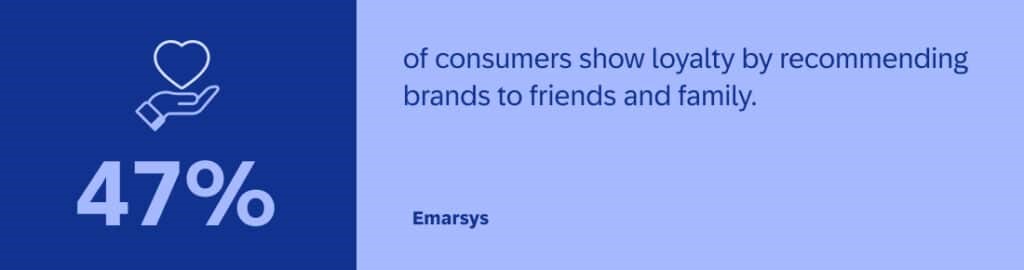
47% of consumers demonstrate their loyalty by recommending brands to friends and family
47% of respondents express their loyalty by recommending brands to friends and family. Word-of-mouth remains a critical driver of customer acquisition, and positive experiences inspire loyalty that extends beyond individual customers.
88% of customers who trust a store will return as a repeat buyer
Trust plays a critical role in fostering customer loyalty. When customers trust a brand, they are more likely to return, leading to repeat purchases. Trust is built through transparency, consistent quality, and excellent service, making it a cornerstone for long-term relationships and business growth.
Four imperatives to win the consumer of the future (State of the Consumer 2024: What’s now and what’s next)
Build microtargeting capabilities
Rather than putting consumers in predefined—and often outdated—boxes, companies should focus on microtargeting to build a richer understanding of consumer preferences. This involves taking a “smart reach” approach, whereby consumer businesses use their consumer data to target specific microsegments of consumers who may demonstrate particular shopping behaviours or preferences. Generative AI can help consumer businesses reach these microsegments at scale by increasing creative output and automating marketing outreach. Through microtargeting, companies can engage high-potential consumer groups—for example, younger people in emerging markets or wealthy aging individuals—and provide personalized experiences that build brand love and loyalty and propel future purchases.
Invest in wellness
A rise in both consumer interest and purchasing power presents tremendous opportunities in the $1.8 trillion global-consumer-wellness space. Consumer goods leaders have a chance to revaluate their product development road maps and consider whether they have more opportunities to introduce personalized-wellness products to priority consumer groups. Consumers across the globe want data- and science-backed health and wellness solutions. Best-in-class companies should evaluate opportunities to lean into these offerings and other wellness growth areas (such as women’s health and healthy aging).
Propel the social–digital experience
Companies should take steps to engage with consumers on social media and other digital platforms. This involves identifying the right channels and platforms, creating attractive content, and tailoring strategies to meet evolving consumer needs. This is especially important as industry lines blur (for example, as consumer companies enter the healthcare space and vice versa) and as ecosystems (networks or partnerships that cut across different industries) become more important. We see innovative, international companies testing new approaches to social commerce to connect with consumers on a local level. Some are mobilizing local key opinion leaders to precisely target consumers and create viral digital campaigns that resonate with them. Social media and private chats through platforms such as WeChat help to continually engage consumers.
Offer premium products where they matter
Offering premium products in relevant categories can help improve brand loyalty. Consumer brands should identify which categories are ripe for this, such as experiential travel—where splurge activity is common even across middle-income and aging consumers. Conversely, some categories are more suitable for value plays based on trade-down behaviour or frequent brand exploration. Integrating loyalty and pricing strategies, instituting pricing tiers, and tailoring product assortments at the local and channel levels are ways that consumer businesses can provide value to consumers, while also managing economic pressures.
In this consumer landscape—one in which standards, complexity, and stakes are all higher—leaders should understand the new nuances that define who the “next” shoppers are, what they care about, and how they shop. These insights, which should then inform strategic category and channel investments, can lead to long-term, profitable growth and sustained competitive advantage.